


 Add
AddAir quality in Atlanta
Air quality index (AQI⁺) and PM2.5 air pollution in Atlanta • 153.4K Followers • 16:00, Oct 01 Local time
37
US AQI⁺Good

Main pollutant:
PM2.5
6.7 µg/m³

29°

15 km/h

59 %
Hourly forecast
Atlanta air quality index (AQI⁺) forecast


Daily forecast
Atlanta air quality index (AQI⁺) forecast
| Today | 39 |  | 29° 21° |  16 km/h | 75% |
| Fri | 56 |  | 28° 22° | 11 km/h | 80% |
| Sat | 60 | | 27° 20° | 27 km/h | 87% |
Air pollutants
What is the current air quality in Atlanta?

PM2.5 concentration is currently 1.3 times the World Health Organization annual PM2.5 guideline value.
Health recommendations
 Enjoy outdoor activities |
 Open your windows to bring clean, fresh air indoors Get a monitor |
Pollen
What is the pollen count in Atlanta today?
Index

Low
 Tree None | 0% |
 Grass Low | 25% |
 Weed None | 0% |
Source:
wetter.comHealth recommendations
Enjoy outdoor activities |
Open your windows to bring clean, fresh air indoors Get a monitor |
Pollen
What is the pollen count in Atlanta today?
Index
Low
Tree None | 0% |
Grass Low | 25% |
Weed None | 0% |
Source:
wetter.comMost polluted locations near Atlanta
Worldwide AQI⁺ ranking
Station ranking
Real-time AQI⁺ station ranking for stations in Atlanta

City ranking
Real-time USA AQI⁺ city ranking
Historic air quality near Atlanta
History
Historic air quality graph for Atlanta
Historic air quality near Atlanta
History
Historic air quality graph for Atlanta
Most polluted locations near Atlanta
Worldwide AQI⁺ rankingStation ranking
Real-time AQI⁺ station ranking for stations in Atlanta
City ranking
Real-time USA AQI⁺ city ranking




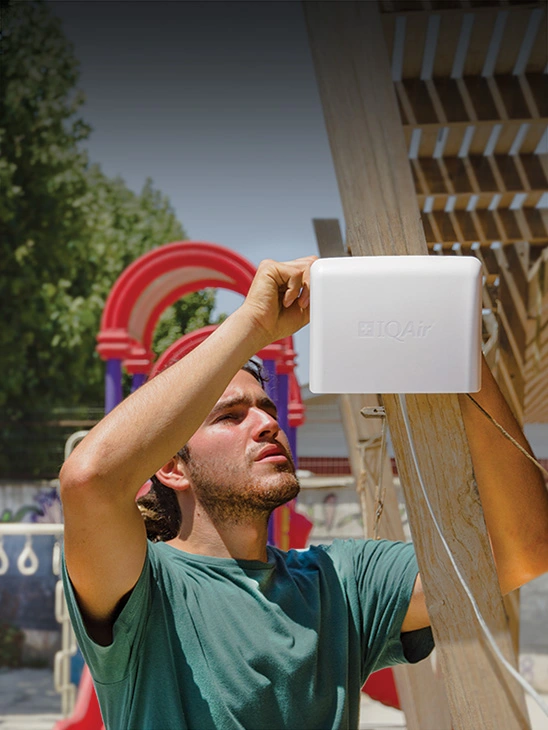
Measure your own air quality
Get a monitor and contribute air quality data in your city.
Learn more about global air quality


Learn more about air pollution in Atlanta
What is the current air quality in Atlanta?
The current air quality in Atlanta is considered good. Air pollution levels are low and there are no expected health risks, making it a good time to enjoy normal outdoor activities.
What is smog in the Atlanta metro area?
Smog is a combination of pollutants, including ozone and particle pollution, that contribute to reduced visibility. To better understand smog in Atlanta, it’s important to understand each of these pollution components.
Ozone is a highly reactive, highly irritating gas molecule composed of three oxygen atoms. Unlike the majority of federally measured air pollutants, which are emitted from various sources of combustion, ozone is formed in the air from the existence of other pollutants reacting under sunlight.
When breathed in, ozone attacks the lungs by chemically reacting with lung tissue, causing health complications ranging from a cough and difficulty breathing to respiratory infections and premature death.
According to the 2020 State of the Air report published by the American Lung Association, Atlanta is rated an “F” for ozone pollution.1 Fulton county, of which Atlanta is the county seat, has failed to meet ozone attainment levels since at least 1996.
Federal ozone targets are formatted as a number of days that exceed healthy levels. Orange days describe conditions between AQI 101 and 150, while red days describe conditions when AQI is between 151 and 200. Both unhealthy ozone days require hot temperatures and relatively stagnant air.
Atlanta air quality tends to average 40 ‘code orange’ days a year.2 On these unhealthy ozone days, the Centers for Disease Control and Prevention (CDC) estimate that there is a 35 percent increase in hospital visits for respiratory-related illnesses, mainly among those categorized as “sensitive” to air pollution. Sensitive individuals include children, the elderly, and those with pre-existing respiratory conditions. In Fulton county, this includes an estimated 90,736 people with pediatric or adult asthma, 57,077 with COPD, 68,893 with cardiovascular disease, 229,407 children under the age of 18, and 122,730 adults over the age of 65.
Likely indicative of Georgia ozone challenges, 12 percent of the state’s children suffer from asthma, nearly 50 percent higher the national average.3
For fine particle pollution, another pollutant of key concern in the area, Atlanta air quality receives a passing grade of “B.” Particle pollution is a mix of ash, soot, diesel exhaust, chemicals, metals, and aerosols that are near microscopic in size. These particles can burrow deep within the lungs, triggering health concerns including asthma, difficulty breathing, and respiratory irritation as well as heart attacks, strokes, and lung cancer. While Atlanta has met federal attainment levels for annual and 24-hour PM2.5, 2019 saw increases in both measures. Its passing grade for annual PM2.5 exposure was achieved by a tiny 0.1 μg/m³ margin. In 2019, Atlanta averaged a PM2.5 level of 11.9 μg/m³ (the federal target is 12 μg/m³). The city meanwhile fails to meet the more stringent World Health Organization (WHO) target for annual PM2.5 exposure of 10 μg/m³.
In 2019, Atlanta particle pollution was comparable to, but slightly worse than, more notoriously polluted Bakersfield, California (11.3 µg/m³) and Baltimore, Maryland (11.2 µg/m³). Such comparison draws attention to the often overlooked threat of Atlanta’s particle air pollution.
In Atlanta, smog and periods of elevated particle and ozone pollution tend to coincide in the summer, often reaching dangerous levels. In 2019, Atlanta air quality index levels reached their highest levels from May through September. Each month in this 5-month period received an AQI rating of “moderate,” exceeding federal standards.
What causes air pollution in Atlanta?
When it comes to clean air, Atlanta gets an “F” for ozone pollution. Ozone is referred to as a “secondary” pollutant because it is not emitted directly but rather formed when two primary pollutants, nitrogen oxides (NOx) and volatile organic compounds (VOCs), react in sunlight.
In Atlanta, air pollution sources for nitrogen oxides primarily include mobile vehicular emissions (67 percent), fuel combustion (non-vehicular, 18 percent), industrial processes (5 percent) and fires (4 percent).4 Sources of volatile organic compounds, on the other hand, primarily include releases from plants and animals (84 percent) and mobile vehicular emissions (6 percent). Both primary pollutants can additionally be transported by wind from neighboring cities and states.
Since ozone is a gas formed in the air from precursor pollutants with a range of sources, it is relatively difficult to manage. The increased prevalence of sunlight and heat in the summer results in increased ozone levels in Atlanta summer months. This trend is common across cities in the northern hemisphere.
Atlanta is a quickly growing city, sprawling with development and likewise growing in vehicles on the road and distances traveled. By 2050, it is estimated that the population will increase by a whopping 51 percent, adding 2.9 million people.5 With this tremendous growth comes increases in emission sources by way of construction, traffic, personal emissions, and budding industry.
Presently, car and truck tailpipe emissions bear the blame for Atlanta ozone due to this source’s significant impact on the prevalence of nitrogen dioxide, a key ozone precursor pollutant.
How much air pollution comes from cars in Atlanta?
Cars are responsible for a significant amount of Atlanta air pollution. Specifically, vehicle emissions account for 71 percent of airborne lead (Pb), 67 percent of nitrogen dioxide (NO2), 57 percent of carbon dioxide (CO), 6 percent of volatile organic compounds (VOCs), 5 percent of fine particulate matter (PM2.5), and 2 percent of coarse particulate matter (PM10).
Since vehicular emissions are the leading cause of nitrogen dioxide pollution in Atlanta, this emission source is often blamed for Atlanta ozone challenges.
According to the Georgia Department of Natural Resources, Atlanta ranks 2nd nationally for most air pollution from motor vehicles. This may be of little surprise considering that Atlanta is well known for its traffic and city sprawl.
Atlantans drive upwards of 100 million miles a day – the average daily commute of residents is 34.2 miles, the fourth-highest daily driving distance in the country. Commuters often lose up to 60 hours a year sitting in traffic. When cars idle in traffic, they continue to emit air pollution.
Shifts towards cleaner, more fuel-efficient vehicles, such as electric and hybrid vehicles, offer an opportunity for Atlanta to drive down air pollution levels further. In 2015, Georgia quashed tax credits for electric vehicles, resulting in a 90 percent reduction in electric car registrations and emphasizing the importance of the state in promoting such new technology.6 Recently, the shift towards electric vehicles has begun to win bipartisan support. This shift is important for the state to take action to clean up air quality in Atlanta as well as air quality in other congested cities in the state.
An increase in public transport offers another avenue. It is estimated that current public transit reduces the time people spend in traffic by as much as 32 percent. Growing this figure further could be possible with increased availability of public transit routes and more city sidewalks.
Why is Atlanta air quality bad today?
Atlanta air quality may suffer for a variety of different reasons, varying day to day. Trends reveal common exacerbating factors that provide insights to source mitigation and exposure reduction.
A combination of ozone and fine particle pollution (PM2.5) most often plague Atlanta air quality. Atlanta live air quality data is displayed prominently at the top of this page. The “main pollutant” field indicates the pollutant currently at the highest or riskiest level. This pollutant’s measurement dictates the overall AQI score. When PM2.5 is listed as the main pollutant, this may be indicative of nearby fires or wood burning, dust from construction activity, or industry and traffic. When ozone pollution is the main pollutant, this is often indicative of high temperatures, stagnant air, and the prevalence of precursor pollutants from vehicles, industry, and neighboring cities and states.
Both measures experience heightened levels in the summer. For ozone pollution, this trend is unsurprising, as sunlight is required for the pollutant’s formation. Particle pollution may also be elevated during these months as a result of increased building cooling, car idling, and construction projects.
Use Atlanta forecast air quality data to plan ahead and take precautionary measures to reduce your pollution exposure throughout the year.
Is air quality better on the westside of Atlanta?
Atlanta air quality varies across the city, with the westside often experiencing cleaner air quality than the east. This trend can be partially understood by the city’s geography.
Air pollution tends to disproportionately affect groups of lower socioeconomic status.7 This correlation is the result of industry and certain city features that are major sources of air pollution, such as major roadways, airports, and industrial complexes, being intentionally situated near low-income neighborhoods and housing.
The inequitable environmental burden placed on lower income groups affects a large share of racial minorities. These populations not only suffer poorer air quality but also poorer health as a result. A study conducted on demographic inequities and health outcomes in the Atlanta area found that neighborhoods of lower socioeconomic status, such as those in the east side of Atlanta, have a higher prevalence of cardiovascular and respiratory diseases as a result of increased air pollution exposure. 7 These disparities should be addressed in order to promote the health and prosperity across the city.
Use the Atlanta air quality map to observe hyperlocal changes in pollution levels. Air quality monitoring in the east Atlanta area is currently lacking. Insights driven by artificial intelligence are currently providing the only snapshot to air quality in east Atlanta. Crowd-sourced data can offer an opportunity to better measure and manage air pollution levels in east Atlanta in the future. Learn how to become a contributor of measured air pollution data.
+ Article Resources
[1] American Lung Association. (2020). State of the air – 2020.
[2] Southern Environmental Law Center. (2005). Facing the facts about Atlanta’s air quality.
[3] Miller A. (2012, May 23). Asthma numbers grim — particularly for kids.
[4] Air Georgia. (2020). Ambient air monitoring program.
[5] Atlanta Regional Commission. (2020). Population and employment forecasts.
[6] Berman B. (2019, December 18). Meet the Georgia Republican politician pushing hard for EVs.
[7] Servadio J, et al. (2019). Demographic inequities in health outcomes and air pollution exposure in the Atlanta area and its relationship to urban infrastructure. DOI: 10.1007/s11524-018-0318-7