

 Add
AddAir quality in Avellino
Air quality index (AQI⁺) and PM2.5 air pollution in Avellino • 5.4K Followers • 21:00, Aug 13 Local time
108
US AQI⁺Unhealthy for sensitive groups

Main pollutant:
PM2.5
38.4 µg/m³

24°

7 km/h

61 %
Hourly forecast
Avellino air quality index (AQI⁺) forecast


Daily forecast
Avellino air quality index (AQI⁺) forecast
| Today | 99 |  | 35° 22° |  19 km/h | 38% |
| Fri | 53 | | 34° 21° | 17 km/h | 36% |
| Sat | 57 | | 34° 19° | 14 km/h | 35% |
Air pollutants
What is the current air quality in Avellino?

PM2.5 concentration is currently 7.7 times the World Health Organization annual PM2.5 guideline value.
Health recommendations
 Reduce outdoor exercise |
 Close your windows to avoid dirty outdoor air Get a monitor |
 Sensitive groups should wear a mask outdoors Get a mask |
 Run an air purifier Get an air purifier |
Pollen
What is the pollen count in Avellino today?
Index

Low
 Tree None | 0% |
 Grass Low | 25% |
 Weed None | 0% |
Source:
Open-Meteo.comHealth recommendations
Reduce outdoor exercise |
Close your windows to avoid dirty outdoor air Get a monitor |
Sensitive groups should wear a mask outdoors Get a mask |
Run an air purifier Get an air purifier |
Pollen
What is the pollen count in Avellino today?
Index
Low
Tree None | 0% |
Grass Low | 25% |
Weed None | 0% |
Source:
Open-Meteo.comMost polluted locations near Avellino
Worldwide AQI⁺ ranking
Station ranking
Real-time AQI⁺ station ranking for stations in Avellino

Historic air quality near Avellino
History
Historic air quality graph for Avellino
Historic air quality near Avellino
History
Historic air quality graph for Avellino
Most polluted locations near Avellino
Worldwide AQI⁺ rankingStation ranking
Real-time AQI⁺ station ranking for stations in Avellino



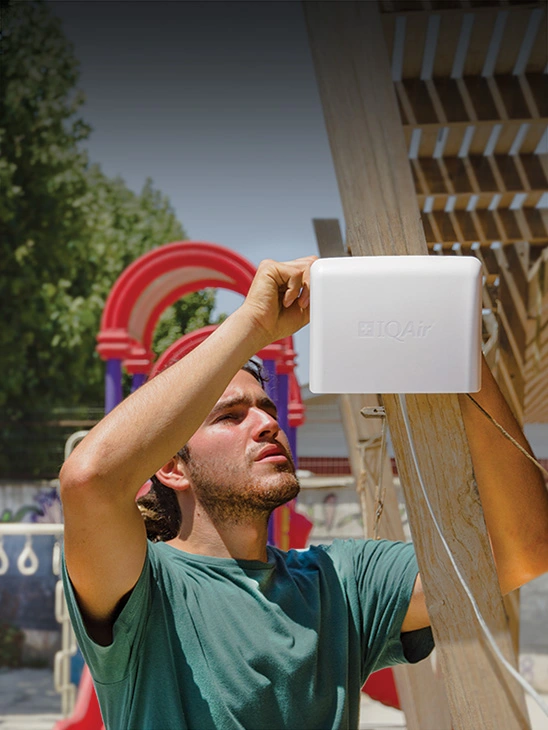
Measure your own air quality
Get a monitor and contribute air quality data in your city.


Learn more about air pollution in Avellino
What is the current air quality in Avellino?
The current air quality in Avellino is considered unhealthy for sensitive groups. Children, older adults, and people with heart or lung conditions may experience health effects, while the general public is less likely to be affected.
What is the current level of air pollution in Avellino?
Avellino is a town and commune, capital of the province of Avellino in the Campania region of southern Italy. It is located 47 kilometres east of Naples on a large plain surrounded by mountains. According to a census conducted in 2017, Avellino had an estimated population of approximately 55,000 people.
Towards the end of 2021, Avellino was experiencing a period of air quality that was classified as being “Moderate” with a US AQI reading of 51. This reading is used as a reference point when comparing air quality in other cities around the world. Data is collected with regards to the six most prolific air pollutants commonly found and this figure is calculated from there. If information is not available for all six, then a figure can be deduced using the information that is available. In the case of Avellino, only PM2.5 was measured which was found to be 12.1 µg/m³.
This PM2.5 level can be seen to be slightly higher than the suggested level of 10 µg/m³. This level has been determined by the World Health Organisation (WHO) as being an acceptable level of air pollution, although no level is to be considered as being safe.
When the level of pollution is in the “Moderate” category, the given advice would be to remain indoors as much as possible, closing all doors and windows to prevent more dirty air from entering the rooms. Those of a sensitive disposition should not venture outside if possible until the air quality has improved. If it is unavoidable, then a good quality mask should be worn at all times.
There is a mobile app available from AirVisual.com for most operating systems. This free app informs you of the state of the air in real-time and thus will help you decide what to do or where to go.
Does the level of air pollution vary throughout the year in Avellino?
Air pollution can be very volatile and can change very quickly. Looking at the figures for 2020 published by IQAir.com. it can be seen that the worst month for air quality was January when a figure of 36.1 µg/m³ was recorded. This classified it as being “Unhealthy for sensitive groups”. For the remaining eleven months, the air quality was classified as being “Moderate” with readings between 12.1 and 35.4 µg/m³. The best month being June with a 12.1 µg/m³ figure, the worst being November with a level of 31.2 µg/m³.
Historically, records for air quality have been kept for Avellino since 2017 when a figure of 18.3 µg/m³ was recorded. The following year of 2018 saw an improvement with a figure of 15.1 µg/m³. Another improvement was recorded the next year with a 14.2 µg/m³ figure. But surprisingly, the following year of 2020 saw a decline when the recorded level was 21.0 µg/m³. This is surprising because of the measure put in place to try to stop the spread of the COVID-19 virus. Many motorists were no longer required to commute to their offices each day which reduced air pollution in the city centres dramatically. There were also some factories and similar production units which were told to close on a temporary basis. Many cities throughout the world noted how much cleaner their city air was because of these measures.
Is there a main source of air pollution Avellino?
Avellino is neither a city with an industrial concentration nor a large one. The pollution is explained above all by the unfavourable geomorphological characteristics of the capital, located in a basin surrounded by hills with a strong tendency to stagnation, to the formation and accumulation of polluting elements coming from vehicular traffic - rather heavy in the streets of the centre -, from heating (especially in conjunction with the harsh winter temperatures) but also from the intense anthropogenic and productive activities located in the municipalities of the hinterland, which enclose Avellino in a narrow urban belt.
As an agricultural centre, there is a lot of organic waste burnt at the end of the growing period. Unfortunately, this increases the level of PM10 to an unacceptable level.
What can be done to improve the air quality in Avellino?
Instead of the squeeze on the cars there was one on boilers. The administration effectively lowered the maximum temperature of the heating systems. This was the highlight of the new provision signed by the mayor of Avellino, to counter the escalation of fine particles in the city. The ordinance came into effect from February last year. For schools, offices and private homes, the maximum temperature ceiling will be 18 degrees, which is 2 below the 20 set by law. Likewise, as widely announced, the practice of burning plant residues was reduced. From a maximum of 2 days a week to 1 day only.
What are the detrimental effects to human health through polluted air?
The negative effects of pollution are not limited to humans but involve all living beings, just think of the acid rains that cause serious damage to woods, waters and monuments.
Every year in industrialized countries billions of tons of pollutants are produced and released into the atmosphere, more than 3,000 have been identified, the most important are: sulphur oxides, nitrogen dioxide, ozone, carbon monoxide and particulate matter. They come largely from different combustion processes; sulphur oxides from coal combustion, nitrogen dioxide and ozone and carbon monoxide from motor vehicles, industrial combustion processes and residential heating.
Exposure to pollutants has been associated with a great variety of harmful effects and most of them, in particular, mainly affect the respiratory and cardiovascular systems. The problem of pollution is underestimated by the population, as the most frequent effects are the less serious ones, which appear asymptomatic or in any case do not require hospitalisation.
Carcinogenic agents are agents that induce cancer or that are capable of increasing its frequency of occurrence in an exposed population. Many individual factors such as smoking, alcohol consumption, nutrition and heredity have considerable influence in the appearance of neoplasms, but often the triggering factor of this disease can be represented by exposure to chemical agents, as is the case of atmospheric pollutants.
Among the most important carcinogens are polycyclic aromatic hydrocarbons (PAHs) which are formed from the incomplete combustion of organic substances.
They are the carcinogenic components of tar and are found in the exhaust fumes of cars, in the black smoke of diesel engines and in the tar of tobacco smoke.